My 2026 Tech Forecast: Future Tech Trends Beyond the Hype
I still have the notes from a tech conference I attended back in 2010. The big prediction? That by 2015, we’d all be wearing clunky augmented reality glasses to order coffee. It didn’t quite pan out. After 15 years of navigating this industry, from coding in basements to advising startups, I’ve learned one thing: predicting the future is less about the flashy gadgets and more about understanding the quiet, underlying shifts in how we interact with technology. I’ve seen countless “next big things” fizzle out, but I’ve also seen the slow-burn ideas that eventually change everything. This isn’t another list of far-fetched fantasies. This is my grounded, firsthand perspective on the future tech trends 2026 that are already taking root and what they actually mean for you, your job, and your daily life. (Source: gartner.com)
What’s Inside
- Trend 1: Ambient Computing Finally Gets Real
- Trend 2: The AI Co-Worker Becomes Standard Issue
- Trend 3: Hyper-Personalization Beyond Annoying Ads
- Trend 4: The Tangible Metaverse (Not Just VR Headsets)
- Putting It All Together: What This Means for You in 2026
Trend 1: Ambient Computing Finally Gets Real
Remember when the ‘smart home’ meant having a single app to turn on a specific light bulb? It was novel, but clumsy. I spent a week in 2017 trying to get three different brands of smart devices to simply work together for a client project. It was a nightmare of incompatible hubs and dropped connections. That’s not the future; that’s a hobbyist’s headache. By 2026, we’ll be deep into the era of ambient computing. This is the idea that technology becomes so integrated into our environment that it effectively disappears. It’s not about logging into a device; it’s about the environment itself responding to your needs. Think of walking into a meeting room, and the displays automatically show your presentation, adjust the lighting to your preference, and transcribe the conversation without you touching a single button. Your car will know your destination from your calendar, adjust the climate based on your smartwatch’s temperature reading, and pay for parking automatically as you leave the garage.
Practical Tip: Start thinking in terms of workflows, not apps. Instead of asking, “Which app do I need for this?” ask, “What is the smoothest way to get this task done?” For your home or business, begin favoring devices that work within open ecosystems (like those supporting the Matter protocol) rather than locking yourself into a single brand. The goal is interoperability.
A Common Mistake to Avoid: The biggest mistake I see people make is investing heavily in a closed ecosystem. You buy a smart speaker, then the doorbell, then the thermostat, all from one company. It feels convenient at first, but you’re trapped. When a better product comes along from a competitor, you can’t integrate it. The future belongs to tech that plays well with others.
The continued development and adoption of standards like Matter are accelerating ambient computing’s practical application. By 2026, we’re seeing more mature integration layers that abstract away the complexity, allowing devices from different manufacturers to communicate more reliably. This means your smart thermostat can intelligently interact with your smart blinds based on real-time occupancy data from your door sensors, creating a truly responsive living or working space without manual intervention.
Trend 2: The AI Co-Worker Becomes Standard Issue
We’ve moved past the novelty of asking an AI to write a poem. The next big step in 2026 technology predictions is the shift from AI as a ‘tool’ to AI as a ‘teammate’. It’s a subtle but profound change. A tool is passive; you pick it up, use it, and put it down. A teammate is proactive, has specialized skills, and collaborates with you.
Last year, my team was tasked with analyzing a massive dataset of customer feedback—thousands of lines of text. The old way would have taken weeks of manual sorting. Instead, we onboarded an AI agent. I didn’t just tell it, “Summarize this.” I gave it a persona: “You are a senior product analyst. Your goal is to identify the top five actionable product complaints and three unexpected feature requests. Ignore feedback related to customer service. Present your findings in a table with columns for the issue, sentiment score, and a direct quote.” It did in 20 minutes what would have taken us two weeks. We then debated its findings, asked it for clarifications, and had it run new queries. It was a conversation, a collaboration.
By 2026, this will be normal. Accountants will have AI partners that flag anomalies in real-time, doctors will have AI assistants that prep patient histories before an appointment, and programmers will have AI agents that write boilerplate code and run diagnostics continuously. Specialized AI models are now fine-tuned for specific industries, offering highly accurate insights and automating complex tasks that previously required extensive human expertise.
Trend 3: Hyper-Personalization Beyond Annoying Ads
Personalization today mostly means seeing an ad for shoes you looked at last week. It’s basic and often just intrusive. The emerging tech in this space is about creating adaptive experiences in healthcare, education, and entertainment that are genuinely helpful.
“71 percent of consumers expect companies to deliver personalized interactions. And 76 percent get frustrated when this doesn’t happen.” – McKinsey & Company
This demand is pushing technology toward true 1-to-1 experiences. Imagine a fitness app that doesn’t just give you a generic workout plan. It connects to your health tracker, notes you slept poorly, and automatically swaps your high-intensity workout for a recovery session. Or consider a corporate training platform that detects you’re struggling with a concept and serves up a different video explanation or a hands-on exercise to help, all without you having to ask.
This is one of the most significant future tech trends 2026 because it touches everything. Your news feed will be a unique blend of formats (text, audio, video) based on what you engage with most. Your car’s interface will reconfigure itself to show the controls you use most frequently based on your current driving context.
The sophistication of generative AI in 2026 allows for dynamic content creation tailored to individual user profiles. Instead of pre-written content, platforms can now generate explanations, summaries, or even creative pieces on the fly, ensuring that the information presented is not only personalized in topic but also in style and complexity, making learning and engagement far more effective.
Trend 4: The Tangible Metaverse (Not Just VR Headsets)
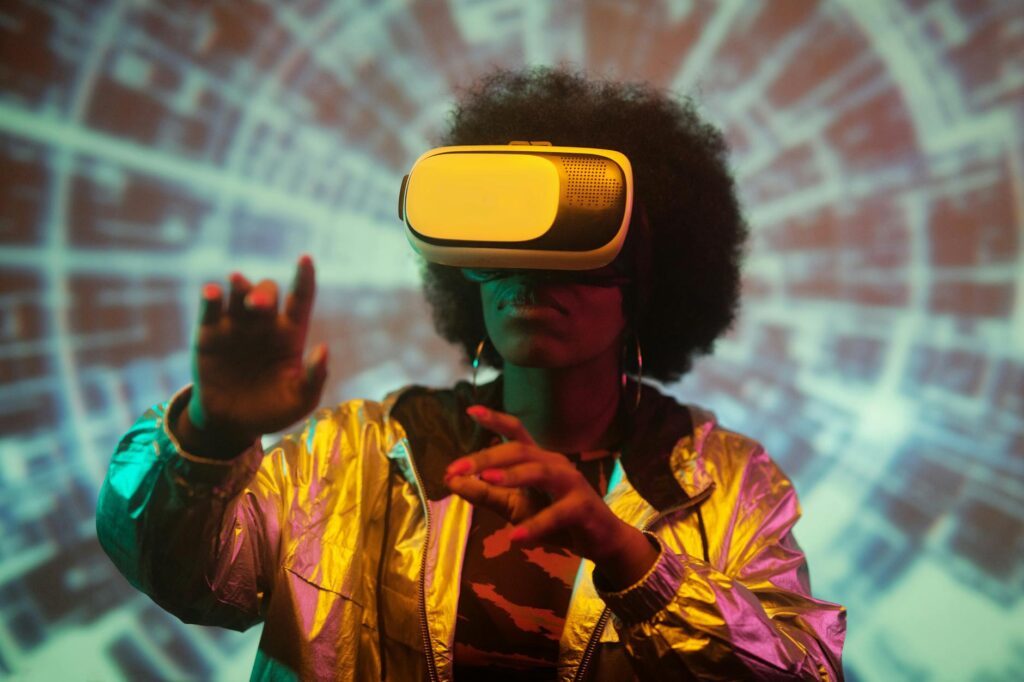
The word “metaverse” still conjures images of bulky VR headsets and purely digital avatars. While those elements will persist, the real evolution by 2026 is the move towards a more integrated, tangible metaverse. Think less about escaping reality and more about augmenting it with persistent digital layers that interact with the physical world.
We’re seeing this in the rise of advanced AR glasses that are becoming more discreet and functional. Imagine walking through a historical site and seeing an overlay of how it looked centuries ago, or a retail store where you can see product information and reviews by simply looking at an item. This isn’t about fully immersive VR, but about enriching our existing physical experiences with contextual digital information and interactions.
Furthermore, the development of haptic feedback suits and more sophisticated spatial audio is making digital interactions feel more real. This bridges the gap between the digital and physical, allowing for more nuanced collaboration in virtual spaces or more engaging remote learning experiences. The focus is on blending digital elements into our physical lives rather than replacing them.
Putting It All Together: What This Means for You in 2026
These trends aren’t happening in isolation. Ambient computing provides the infrastructure for AI teammates to operate contextually. Hyper-personalization ensures that the AI and ambient systems understand and adapt to your unique needs. The tangible metaverse offers new interfaces and interaction models for these blended realities.
For you, this means a future where technology is less of a tool you actively manage and more of an environment that supports you. Your work will likely involve more collaboration with AI, requiring you to hone your strategic thinking and communication skills. Your personal life will be more tailored, with services and information adapting to your preferences and needs in ways that feel helpful, not intrusive. The lines between your physical and digital worlds will blur, creating richer, more informed experiences.
Frequently Asked Questions
What is ambient computing in 2026?
Ambient computing in 2026 refers to technology that is so deeply integrated into our environment that it becomes invisible. It anticipates user needs and responds contextually without requiring direct interaction, making technology feel like a natural extension of our surroundings.
How is the metaverse evolving beyond VR in 2026?
The metaverse in 2026 is evolving to include tangible elements like advanced AR glasses that overlay digital information onto the physical world, and sophisticated haptic feedback systems that enhance sensory experiences. The focus is on augmenting reality rather than replacing it with purely virtual environments.
Will AI replace jobs by 2026?
While AI will automate many tasks, the trend in 2026 is towards AI as a co-worker or assistant, augmenting human capabilities rather than outright replacing them. Jobs will evolve, emphasizing skills like strategic direction, critical thinking, and human-AI collaboration. New roles focused on AI management and ethics are also emerging.