This guide covers everything about tyre change tool. Latest Update (April 2026)
The landscape of tyre maintenance tools continues its rapid evolution in 2026. Recent developments highlight significant innovations in both manual and powered solutions designed to enhance efficiency and user experience for DIY enthusiasts and professional mechanics alike. For instance, CushCore recently introduced a new rotary tyre tool engineered to expedite tyre changes, a development reported by Pinkbike. This introduction underscores a growing industry focus on user-friendly and time-saving equipment. Concurrently, ongoing comparative analyses and rigorous testing of cordless impact wrenches, frequently featured in automotive publications like Car and Driver, consistently showcase the remarkable advancements in battery-powered automotive tools. These improvements make them increasingly attractive and viable options for home mechanics prioritizing speed and convenience in their maintenance routines. Experts also continue to meticulously review and recommend specific types of tyre levers and inflation guns, ensuring that even the most fundamental tyre-changing components benefit from ongoing technological advancements in 2026.
Last updated: April 26, 2026
What Tools Are in a Standard Vehicle Tyre Change Kit?
Most new vehicles arrive equipped with a basic tyre change kit. However, the components within these factory-supplied sets are generally designed for minimal, emergency use rather than sustained reliability or optimal ease of operation. This standard kit typically includes a scissor jack and a simple, L-shaped lug wrench. While these tools can function adequately in a pinch, they often demand substantial physical exertion and can prove unstable or challenging to use effectively, particularly in adverse conditions such as uneven terrain or inclement weather.
The scissor jack operates via a long threaded screw that gradually elevates the vehicle. Its compact design makes it a popular choice for manufacturers seeking to maximize space efficiency within a vehicle’s trunk. Nevertheless, its operation can be tedious, and it necessitates a perfectly flat, stable surface for safe deployment. The basic lug wrench, frequently constructed from thin metal, offers limited use, making it difficult to break loose tightly torqued wheel nuts, especially those that were initially installed using a high-powered pneumatic wrench at a service center. Recognizing the inherent limitations of this basic tyre change tool set is the crucial first step toward assembling a more reliable and safer personal toolkit.
Which Manual Tyre Change Tools Offer the Best Upgrade?
Upgrading your manual tyre change tools represents arguably the most cost-effective strategy for making the process of changing a tyre faster, safer, and less physically demanding. The most impactful upgrades focus on enhancing use, improving stability, and increasing overall usability. A 4-way lug wrench (also known as a cross wrench) and a hydraulic bottle jack stand out as two of the most significant improvements you can make to your emergency toolkit.
A 4-way lug wrench provides multiple use points and facilitates two-handed operation, dramatically increasing torque application and simplifying the loosening of stubborn lug nuts. When selecting one, opt for a model constructed from forged steel for superior durability. Ensure it includes common socket sizes to accommodate various vehicles, as lug nut sizes can differ significantly. A hydraulic bottle jack or a compact trolley jack offers a substantial upgrade over the often flimsy scissor jack. These jacks utilize hydraulic fluid to lift the vehicle through simple handle pumps, requiring considerably less effort and providing a much more stable and secure lifting platform. For individuals who prefer a manual approach but require maximum torque for loosening nuts, a breaker bar paired with the correct socket size presents another excellent and highly recommended alternative. According to independent reviews and user feedback, these manual upgrades consistently offer a level of reliability that battery-powered tools might not always guarantee in extreme or prolonged usage scenarios.
| Tool Type | Standard Issue (Included with Car) | Upgraded Manual Option | Primary Benefit of Upgrade |
|---|---|---|---|
| Lifting Device | Scissor Jack | Hydraulic Bottle Jack / Compact Trolley Jack | Easier lifting, greater stability, less effort |
| Lug Nut Remover | L-Shaped Lug Wrench | 4-Way Cross Wrench / Breaker Bar with Socket | Superior use, less physical exertion |
| Stability Assurance | None (relies solely on parking brake) | Wheel Chocks | Prevents vehicle from rolling, critical safety enhancement |
Are Power Tools a Good Choice for Tyre Changes?
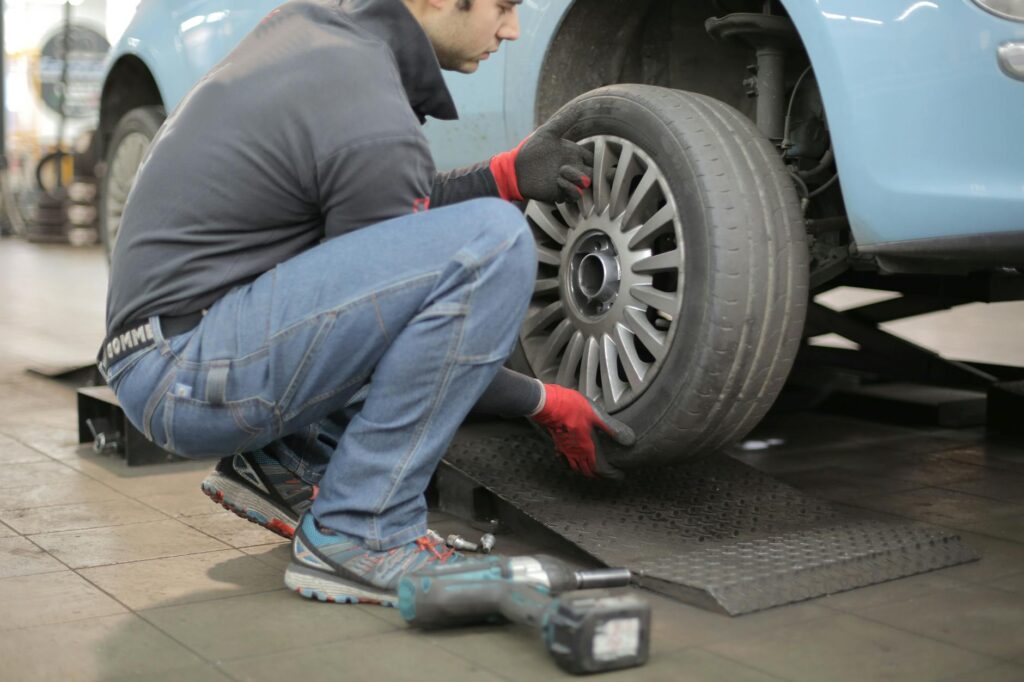
Cordless impact wrenches have rapidly become indispensable tyre change tools, offering unparalleled speed and convenience. Leading manufacturers such as DEWALT, Makita, and Ryobi consistently introduce powerful, battery-operated impact wrenches capable of removing lug nuts in mere seconds. As demonstrated in numerous comparative tests conducted by reputable automotive publications like Car and Driver, these tools have seen significant advancements in both power output and battery longevity. However, their operation demands considerable caution and the correct technique to prevent potential damage to your vehicle’s components.
The primary advantage of a cordless impact wrench is its sheer speed. It can drastically reduce the time spent removing all the lug nuts, a task that often proves time-consuming with manual tools. The most significant drawback, however, lies in the substantial risk of over-tightening the lug nuts during the re-installation phase. Overtorquing can lead to severely stretched or even broken wheel studs, warped brake rotors—a costly repair—or cracked alloy wheels. And, lug nuts tightened excessively can become nearly impossible to remove later without specialized equipment. If you choose to use a cordless impact wrench for installation, it should strictly be employed only to lightly snug the nuts. The final, critical tightening must always be performed using a calibrated torque wrench, set precisely to the vehicle manufacturer’s specified torque value.
- Pros:
- Extremely fast removal of lug nuts.
- Requires minimal physical effort.
- Often versatile for numerous other automotive repair and maintenance tasks.
- Cons:
- High risk of over-tightening and causing expensive damage if not used with extreme care.
- Requires at least one fully charged battery for operation.
- Generally carries a higher price point compared to manual tyre change tools.
Why is a Torque Wrench Essential?
A torque wrench is not merely an optional accessory; it’s a fundamental tool for ensuring the safety and integrity of your vehicle’s wheels, especially when using power tools. Its primary function is to apply a precise amount of rotational force (torque) to a fastener, such as a lug nut. Vehicle manufacturers specify exact torque values for lug nuts to ensure the wheel is securely fastened without being over-tightened or under-tightened. Over-tightening, as previously mentioned, can damage studs, rotors, or wheels. Under-tightening is equally dangerous, potentially leading to a wheel loosening and detaching from the vehicle while in motion—a catastrophic failure.
As of April 2026, calibrated torque wrenches are readily available in various forms, including click-type, beam-type, and digital models. Click-type wrenches are popular for their audible and tactile feedback when the set torque is reached. Beam-type wrenches use a pointer and scale to indicate torque. Digital torque wrenches offer the highest precision and often include electronic readouts and alerts. Regardless of the type, ensuring the wrench is properly calibrated according to its specifications (typically annually) is critical for accurate results. Independent tests confirm that using a calibrated torque wrench is the only reliable way to achieve the manufacturer’s recommended tightness for lug nuts, safeguarding against both component damage and critical safety hazards.
Essential Tyre Changing Accessories
Beyond the primary tools for lifting and loosening/tightening lug nuts, several accessories can significantly improve the safety, efficiency, and convenience of a tyre change. Wheel chocks are paramount for safety; they physically prevent the vehicle from rolling while it’s jacked up. As reported by RuhrkanalNEWS, accessories like the Universal M12 X 1.5 Wheel Hanger Alignment Pin Tool are gaining traction for simplifying the process of mounting wheels, acting as a guide to ensure lug bolts align correctly with the hub. This particular tool, often made from durable stainless steel, aids in preventing cross-threading and makes the wheel mounting process much smoother.
Proper tyre inflation is also key. A reliable tyre inflator, especially one with a wall plug option for continuous power, is a must-have. Texas Diamond Garage recently highlighted the importance of such tools, noting that maintaining correct tyre pressure is essential not only for safety and handling but also for optimizing fuel efficiency. A quality inflator allows for precise pressure adjustments. Even simple items like a sturdy pair of work gloves can prevent hand injuries and improve grip. A flashlight or headlamp is indispensable for working in low-light conditions, ensuring you can see clearly what you are doing. For those dealing with tubeless tyres, a tyre plug kit can provide a temporary fix for minor punctures, allowing you to drive to a repair shop. The importance of having these supporting items can’t be overstated; they transform a potentially difficult and hazardous task into a manageable one.
Innovations in Tyre Changing Equipment
The tyre service industry continues to see innovation aimed at streamlining processes. As mentioned earlier, Pinkbike reported on CushCore’s new rotary tyre tool, designed to accelerate tyre changes. Such specialized tools, while perhaps more geared towards professional shops or avid cyclists dealing with bicycle tyres, reflect a broader trend towards efficiency. In the automotive sector, advancements are seen in more solid and user-friendly tyre changers, particularly those designed for home garage use. These machines often incorporate features that reduce the physical strain involved in breaking the bead seal and mounting/demounting the tyre from the rim. RuhrkanalNEWS recently featured a Stainless Steel Tire Changer Demount Duck Head Tool, noting its hand-operated nature and applicability to many tire machines, suggesting that even manual components are receiving design attention for improved durability and functionality.
and, the integration of smart technology is slowly making its way into tyre maintenance. While not yet widespread for DIY users, professional tyre shops are beginning to utilize automated systems that can measure tyre wear, balance tyres, and even assess pressure with greater accuracy. For the average vehicle owner in 2026, the focus remains on reliable, well-engineered tools that simplify the process. Innovations in materials science also contribute, leading to lighter yet stronger tools. For example, high-strength aluminum alloys and advanced composites are being explored for tool handles and components, aiming to reduce user fatigue during prolonged use.
Choosing the Right Tyre Levers
Tyre levers are fundamental for separating the tyre bead from the wheel rim. For manual tyre changes, especially on bicycles or smaller vehicles, having a good set of tyre levers is non-negotiable. While basic plastic levers are common, they can flex or break under pressure. Upgraded options are typically made from stronger materials like hardened steel or durable nylon composites. Look for levers with ergonomic handles that provide a comfortable and secure grip, as significant force is often required.
The best tyre levers often feature a curved or hooked end that securely engages with the tyre bead, preventing slippage. Some kits include a third lever to help hold the bead down while you work around the rim. For car tyres, especially those with stiff sidewalls or low-profile designs, more solid lever systems, sometimes including bead-breaking tools, might be necessary. User reports consistently indicate that investing in a quality set of tyre levers saves time and prevents damage to both the tyre and the rim, which can occur with cheaper, less effective tools.
Tyre Inflation Tools and Gauges
Accurate tyre inflation is critical for safety, fuel economy, and tyre longevity. Beyond the inflator itself, a reliable tyre pressure gauge is essential. While many inflators include a built-in gauge, they may not always be the most accurate. Independent testing often reveals significant variations in accuracy between different gauges. As of April 2026, digital tyre pressure gauges are widely available and generally offer superior precision and ease of reading compared to analog models. Look for gauges that read in increments of 1 or 2 PSI and have a wide measurement range.
For those who want to monitor tyre pressure more proactively, especially in vehicles without built-in tire pressure monitoring systems (TPMS), consider investing in aftermarket TPMS sensors or a set of tyre pressure monitoring valve caps. These devices provide real-time pressure readings, often displayed on a small dashboard unit or even a smartphone app. This constant vigilance ensures your tyres are always at optimal pressure, a point reinforced by recent discussions on vehicle maintenance efficiency, such as those found in Car and Driver articles discussing ways to improve vehicle performance and economy.
Frequently Asked Questions
What is the most important tool for a tyre change?
The most critical tools are those that ensure safety and proper function. This includes a reliable jack that can safely lift the vehicle and a torque wrench to correctly tighten the lug nuts. Without these, the process is both dangerous and can lead to vehicle damage or component failure.
Can I use a regular wrench to change a tyre?
A regular wrench is generally insufficient. You need a lug wrench or a socket set with a breaker bar to get enough use to loosen or tighten lug nuts, which are often torqued to high specifications. An L-shaped wrench included in basic kits provides minimal use.
How often should I check my tyre pressure?
According to automotive experts and manufacturers, you should check your tyre pressure at least once a month and before any long journeys. It’s also advisable to check them when temperatures change significantly, as this affects air pressure.
Are cordless impact wrenches safe for lug nuts?
Cordless impact wrenches can be used to remove lug nuts safely. However, for installation, they pose a high risk of over-tightening. If used for installation, always use them only to snug the nuts, followed by final tightening with a calibrated torque wrench or torque sticks.
What’s the best way to store tyre change tools?
Store your essential tyre change tools in a dedicated bag or toolbox within your vehicle, typically in the trunk or under a seat. Keeping them organized prevents them from rattling around and ensures they are readily accessible when needed. Ensure jacks and wrenches are secured to prevent movement during transit.
Conclusion
Choosing the right tyre change tools in 2026 involves balancing cost, convenience, and safety. While basic kits suffice for emergencies, upgrading to better manual tools like a hydraulic jack and a 4-way lug wrench significantly improves the experience. For those prioritizing speed, cordless impact wrenches are powerful options, but they demand careful use, especially during reinstallation, where a calibrated torque wrench is indispensable. Accessories such as wheel chocks, reliable inflation tools, and quality tyre levers further enhance safety and efficiency. By understanding the function and limitations of each tool and incorporating recent innovations and best practices, vehicle owners can confidently and safely manage tyre maintenance tasks, ensuring their vehicle remains in optimal condition on the road.
Source: Britannica
Editorial Note: This article was researched and written by the Serlig editorial team. We fact-check our content and update it regularly. For questions or corrections, contact us.


